The Small Tap: Correcting Brand Drift Without Sanding Away Character
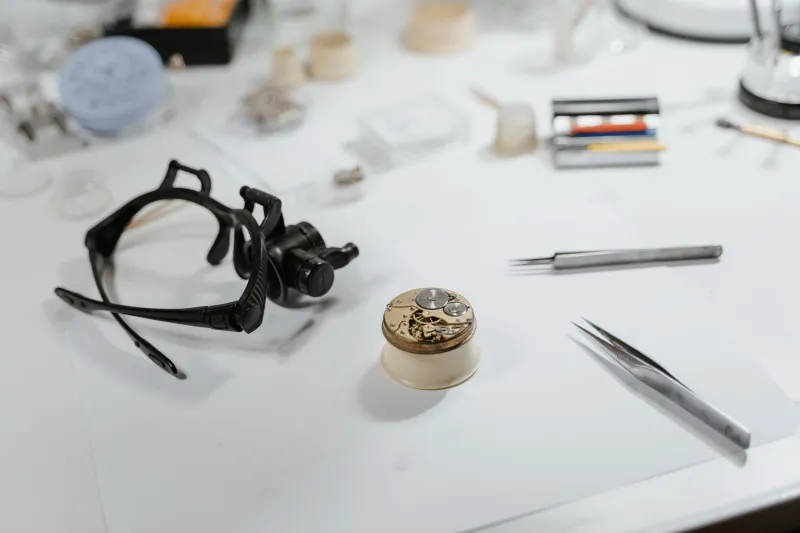
A watchmaker does not replace a wheel because it runs slightly out of round. On the trueing bench, the work is quieter than that: a small tap here, a fractional adjustment there, then another measurement. The aim is not a new wheel. The aim is a wheel that runs true without losing the marks of its making. Brand refinement in the UK would benefit from the same discipline. Too often, the response to inconsistency is a full rebuild — a new identity, a new tone, a new campaign system — when what the brand actually needs is calibration.
What the Bench Teaches
Trueing is an exercise in restraint. The watchmaker knows that every adjustment changes the relationship between parts. Remove too much metal and the wheel will never keep time; leave it untouched and the movement will remain unreliable. The craft lies in knowing which imperfections affect performance and which are simply evidence of character.
Brand work has an equivalent tension. A UK business may have a logo drawn slightly off-grid, a founder's turn of phrase that has survived three strategy documents, or a campaign device that feels old-fashioned but is instantly recognised by customers. These are not automatically problems. Some are the brand's equivalent of a wheel's original grain: the details that make it legible as itself. The question is not whether they are perfect. The question is whether they are doing harm.
Character Is Not the Same as Drift
Drift is what happens when a brand stops making deliberate choices. A colour shifts because a new supplier interpreted the Pantone loosely. A tone of voice becomes more casual because a social team followed a trend. A campaign line is stretched until it means nothing in particular. Drift is accidental, cumulative and usually invisible from the inside.
Character is different. Character is the residue of decisions that were made on purpose and have earned their place. It may look irregular, but it performs a function: it aids recognition, carries meaning or creates familiarity. A Yorkshire manufacturer with an old-fashioned turn of phrase may sound quaint to a new marketing hire, but to a trade customer it signals continuity and trust. A Bristol membership organisation may have a slightly eccentric campaign motif that members look forward to each year. Removing it would tidy the brand and weaken it at the same time.
The calibration question is therefore not 'Is this detail perfect?' It is 'Is this detail productive?'
A Calibration Exercise for Agencies and Clients
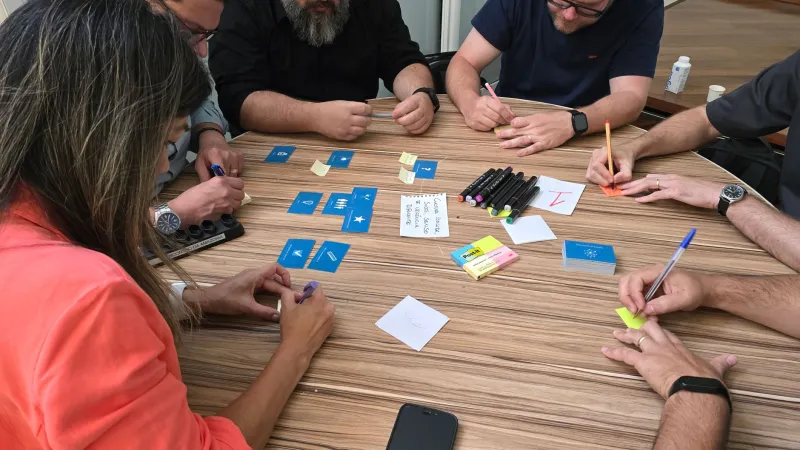
The following exercise is designed for a half-day session between a client team and its creative partner. It borrows the logic of the trueing bench: gather the evidence, measure the effect, adjust in small increments and record what changed.
1. Gather the 'off' details
Ask both sides to list every brand detail that feels slightly irregular. Include visual assets, verbal habits, campaign conventions, service rituals, packaging decisions and digital patterns. Do not filter for quality yet. The point is to surface the details that have survived without being formally endorsed.
2. Test each detail against three questions
For every item, ask:
- Recognition: Would a loyal customer notice if this detail disappeared?
- Meaning: Does it carry a message that supports the brand's positioning?
- Cost: Does it create measurable confusion, inconsistency or operational drag?
A detail that scores highly on recognition and meaning, and low on cost, is a candidate for protection. A detail that scores low on recognition and high on cost is drift. The difficult middle ground — low meaning but high recognition, or high meaning but high cost — requires a small adjustment rather than a binary keep-or-kill decision.
3. Adjust in increments
Choose no more than three details to change in a single cycle. For each, define the smallest possible intervention: a clarified rule rather than a new asset, a tighter example rather than a rewritten tone of voice, a minor refinement rather than a relaunch. The aim is to correct the drift while leaving the character intact.
4. Record and review
The trueing bench depends on measurement. Agree what you will observe after the adjustment: customer recognition, team confidence, consistency across touchpoints or simply the number of exceptions raised in production. Review at a fixed interval — three months is usually enough for a first reading — and decide whether to adjust again or stop.
Where to Look First
Identity work is the obvious starting point. A UK brand may be tempted to redraw a wordmark because it looks uneven at small sizes, when the better answer is a corrected spacing rule that preserves the original drawing. Campaign work offers another useful test. A recurring device — a phrase, a framing device, a visual joke — may feel tired internally but still be doing valuable recognition work externally. Service rituals are often overlooked. The way a business answers the phone, writes an order confirmation or handles a complaint can carry more character than any poster.
The Discipline of the Small Adjustment
The trueing bench is not an argument against change. It is an argument against unnecessary replacement. UK brands operate in a crowded market where distinctiveness is hard won and easily lost. The most valuable refinements are often the least dramatic: a clearer rule, a tighter example, a protected quirk that has earned its place.
Before the next rebuild, it is worth asking what would happen if the brand were adjusted rather than replaced. In many cases, the answer is a movement that runs truer — and still sounds like itself.