Mend Before You Modernise: A Servicing Schedule for UK Brand Systems
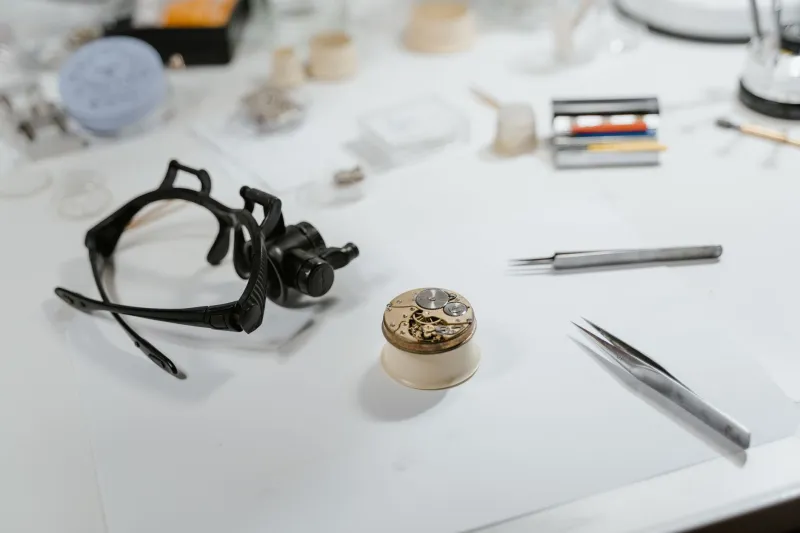
A stopped clock is seldom a dead clock. More often it is dry, dusty or slightly out of beat, and a competent hand can bring it back without touching the dial. Brand systems fail in much the same way, and yet the instinct in most UK boardrooms is not to service but to replace: a new mark, a new palette, a new voice, launched with a film and a set of guidelines nobody reads beyond February. The result is expensive, and worse, it is forgetful. Every wholesale redesign discards recognition that took years to accumulate.
The argument here is not that redesigns are never warranted. Some genuinely are. It is that replacement has become the default answer to a question that has not been properly asked, and that a modest servicing discipline would save a great deal of money while preserving the one asset a brand cannot buy back quickly: familiarity.
What the repair bench knows
Horological conservation is a useful model because it is governed by a principle of minimal intervention. A conservator at a national collection will strip, clean and lubricate a movement, replace a worn pivot or a broken spring, and leave the case and dial almost entirely alone. The patina stays. The evidence of age stays. What is restored is function, not appearance, and the object continues to be itself.
The same restraint runs through British repair culture more broadly. Repair Cafés now operate in most sizeable towns, The Restart Project has made electronics repair a civic activity, and the 2021 right-to-repair provisions in UK eco-design law gave the habit statutory backing. Television has made visible mending familiar and even fond. There is a public appetite for things that are looked after rather than discarded, and it is not sentimental. It is economic.
Brands sit oddly outside this culture. A retailer will repaint an entire fascia when the real fault was signage legibility at forty metres. A membership organisation will commission a new identity when the actual problem was that its tone of voice had drifted into jargon. The diagnosis is skipped, so the repair is aimed at the wrong part.
Three trays on the bench
A servicing schedule is simply a way of sorting faults by the treatment they need. Three trays will do.
The oil tray
These are the systems that have not failed but have dried out. Brand guidelines that exist only as a PDF nobody opens. Asset libraries with no clear owner. Templates that are three software versions out of date. Naming conventions that were never written down and are now reinvented by each new hire. None of this requires a designer's signature; it requires lubrication, and it should happen on a fixed cycle rather than after a crisis. Quarterly attention to these components prevents most of the drift that later gets blamed on the identity itself.
The patch tray
Here we find components that have genuinely worn. A wordmark that no longer reproduces at the small sizes a mobile screen demands. Colour values that have wandered between print, packaging and interface until no two applications agree. Photography that has aged into a particular decade. A strapline that once sounded confident and now sounds like everyone else's.
Patching means repairing the component while preserving the case and dial. A redrawn wordmark that keeps its proportions, an agreed set of colour values with a single source of truth, a refreshed photographic direction that keeps the same subjects. It is careful, unglamorous work, and it is where most of the available value sits.
The replace tray
Replacement is legitimate when the fault is structural. If the proposition no longer describes what the organisation actually does, if the name actively misleads or cannot be protected, if the mark cannot be scaled, licensed or reproduced in the formats the business now depends on, then the movement has failed and no amount of oil will help.
Even then, the case is often worth keeping. A new proposition can sit under an established name. A repaired mark can outlive a changed brand architecture. The question is not whether to replace, but how little to replace.
Four questions before anyone opens the case
First: does it still tell the time? Relevance is functional. If the identity still describes the offer accurately to the audience that matters, its age is not a fault.
Second: does it keep time? Consistency across touchpoints is measurable. Sample twelve applications — website, invoice, van, exhibition stand, recruitment ad, packaging, email signature — and note how many agree. Drift is a servicing issue far more often than a design issue.
Third: does it belong in the room? Categories move. If competitors have shifted wholesale and the brand now reads as dated rather than distinctive, context has changed even where the identity has not failed.
Fourth, and most neglected: can you name precisely what you would lose? If nobody can articulate the recognition, the associations or the internal affection that a replacement would forfeit, the audit is not finished.
The cost of a new case
Replacement carries costs that rarely appear in the first estimate. Staff must be re-educated. Signage, print, vehicles and merchandise must be respecified. Search visibility resets. Suppliers reprint. And because the original fault was never diagnosed, there is a reasonable chance it will recur inside the new system, which is how organisations end up redesigning every five years and wondering why nothing sticks.
A serviced brand behaves differently. It accumulates. Each intervention adds a layer of meaning rather than restarting the count, and after a decade or two it carries the kind of weight that no launch budget can manufacture.
Keep a service record
Finally, keep a log. What changed, when, why, and who signed it off. Watches change hands with their papers, and the papers are part of the value. A brand with a written service history is easier to hand over, cheaper to maintain and considerably harder to talk into an unnecessary rebuild.
The case should be opened only when there is a fault worth finding. More often than not, the dial is fine.